Updated November 9, 2026
Direct Answer
Condensation on the inside of windows in winter forms when warm, moist room air meets glass below the air’s dew point [1]. Fix it by holding indoor humidity at or below 40 percent at 20 to 40°F outside [1] and keeping the glass warmer. Fog that won’t wipe off sits between the panes, a sign of seal failure [2].
TL;DR
- Condensation on the inside of windows in winter forms when moist room air meets glass below its dew point.
- Two things decide it: indoor humidity, and how cold the glass and frame get.
- Keep indoor humidity at or under 40 percent when it’s 20 to 40°F outside, the range Puget Sound January nights fall in.
- Bathroom fans, outdoor dryer and hood vents, a dehumidifier and open blinds by day all cut the moisture.
- If glass still sweats at 40 percent or less, the window is the cold spot. Compare NFRC Condensation Resistance scores (1 to 100).
- Fog that won’t wipe off sits between the panes. It means a failed seal, and it’s permanent.
- Fix a failed seal with a new glass unit if the frames are sound, or a new window if the frames or several units have failed.
One liner: Lower the humidity first; if the glass still sweats, or fogs between the panes, the window is the problem.
Key Numbers
| Stat | What it measures | Source |
|---|---|---|
| 40 percent or less | Indoor humidity ceiling when it’s 20 to 40°F outside | FGIA, 2021 [1] |
| 15 percent or less | Indoor humidity ceiling below minus 20°F outside | FGIA, 2021 [1] |
| 1 to 100 | NFRC Condensation Resistance scale; higher resists condensation better | NFRC, 2024 [3] |
| Below 60 percent, ideally 30 to 50 | Indoor humidity range to limit mold | EPA, 2026 [6] |
| 24 to 48 hours | Window to dry wet materials before mold takes hold | EPA, 2026 [6] |
| 38°F | Average January low, Seattle | NOAA normals 1991 to 2020 [5] |
| 37°F | Average January low, Tacoma and Everett | NOAA normals 1991 to 2020 [5] |
| 1989 | Year IGMA published its definition of a failed glass unit (TB 1205-89) | Louis, 2018, citing IGMA [2] |
Is It Your Humidity or Your Windows?
In short: Both count. Room humidity sets the dew point, and the window decides how cold the glass and frame get, which NFRC rates on a scale of 1 to 100.
Humidity is only half the cause. Condensation forms when the inside surface of the glass or frame drops below the dew point of the room air [1]. So the window’s own surface temperature matters as much as the moisture in the air. The National Fenestration Rating Council (NFRC) says regular fogging on the inside surface can mean it’s time for new windows [3]. It rates this with a Condensation Resistance score from 1 to 100 on the label of certified windows [3]. A higher score means condensation is less likely, and NFRC advises a higher score in colder climates [4].
Picture two windows in the same room, sharing the same air. If only one of them sweats, that window is running colder than the other.
| What you see | What it points to |
|---|---|
| Every window is wet, with musty smells or damp corners | Indoor humidity is too high |
| Water appears after showers or cooking, then clears | A short moisture spike in one room |
| One window or room sweats while others stay dry | A cold window, frame or wall spot |
| Water beads along the bottom edge or frame first | Heat loss at the glass edge or frame |
The quickest test is a hygrometer, a small humidity meter. If it reads 40 percent or less on a 20 to 40°F night and the glass still sweats, the window is the weak point. FGIA sets 40 percent as the indoor ceiling for those outdoor temperatures [1]. Insulating glass with gas fill, warm-edge spacers, low-E coatings and frames with a thermal break all help keep the inside surface warmer [1].
That check matters most in older Puget Sound homes with single-pane glass or aluminum frames. If those windows sweat at sensible humidity, compare the NFRC Condensation Resistance score on any window you price, including single and double-hung replacement windows.
Why Windows Sweat on the Inside in a Puget Sound Winter
In short: Glass is the coldest surface in a heated room, and Puget Sound winter nights in the 30s keep it cold enough to pull water out of indoor air.
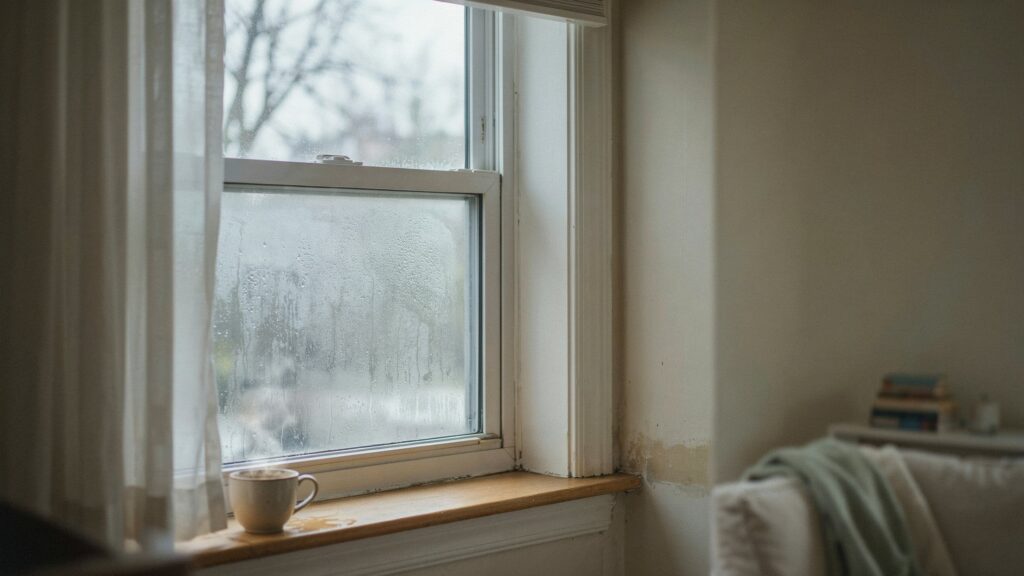
What causes condensation on the inside of windows comes down to cold glass and damp air. Showers, cooking, drying laundry and breathing all add moisture to warm room air. When that air touches a surface below its dew point, the moisture turns to water [1]. In a heated house, the coldest surface is usually the window.
Puget Sound winters set this up night after night. NOAA’s 1991 to 2020 normals put the average January low at about 37 to 38°F in Seattle, Tacoma and Everett [5]. That sits inside the 20 to 40°F band covered by FGIA’s guidance [1].
It also explains why condensation on the inside of windows in morning hours is so common. The glass has cooled all night, blinds or curtains have kept room heat off it, and a closed bedroom has collected a night of breath.
| Number | What it’s for | Source |
|---|---|---|
| 40 percent or less | Clear glass when it’s 20 to 40°F outside | FGIA [1] |
| Below 60 percent, ideally 30 to 50 | Limiting mold growth indoors | EPA [6] |
The EPA range is about mold, and EPA notes window condensation can signal high indoor humidity worth looking into [6]. On cold nights, the 40 percent mark is the one to watch.
How to Stop Condensation on Inside of Windows
In short: Measure first, push moisture outside at the source, dry out damp rooms, and let the glass warm up during the day. Then check again after a week.
All you need to start is a hygrometer, a small humidity meter sold at most hardware stores. Then work through these steps in order.
- Measure the rooms that sweat. Check humidity in the evening and again at dawn. On nights in the 20 to 40°F range, aim for 40 percent or less [1].
- Run fans while the moisture is made. Use the bathroom fan during a shower and keep it on until the mirror clears [3][6]. Use the range hood when you cook [6].
- Send the moist air outdoors. Clothes dryers and kitchen hoods should vent to the outdoors, not into the house [6].
- Dry out damp rooms. If a basement or bedroom stays humid, run a dehumidifier there [6]. FGIA notes a dehumidifier may be needed as part of the heating system [1].
- Let the glass warm up. Open blinds and curtains during winter daylight hours so sun and room heat reach the glass [1].
| Moisture source | Fix |
|---|---|
| Showers and baths | Bathroom fan during and after, until the mirror clears |
| Cooking | Range hood that vents outdoors |
| Clothes dryer | Vent to the outdoors |
| Damp basement or spare room | Dehumidifier |
| Winter humidifier | Turn it down as outdoor temperatures drop |
Two pitfalls catch a lot of homeowners. A humidifier left on a fall setting keeps pushing moisture as nights get colder, while FGIA says indoor humidity should fall as outdoor temperatures do [1]. And EPA ties its open-the-windows tip to days when it isn’t humid outside [6], so on wet Puget Sound days, fans and a dehumidifier carry more of the load.
After a week, check the hygrometer at dawn. If it holds at 40 percent or less and the same windows still drip, the window is the cold spot, as described above.
Foggy Double Pane Windows: On the Glass or Between the Panes?
In short: Wipe the room-side glass. If the fog comes off, it’s room humidity. If it stays, the moisture is sealed between the panes.
A double-pane window is two sheets of glass around a sealed air space, kept dry by a desiccant inside the spacer at the edges [2]. When that seal breaks, moist air gets in, the desiccant fills up, and condensation between window panes forms where no cloth can reach it [2]. A dry cloth at dawn tells you which problem you have.
| Check | On the room-side glass | Between the panes |
|---|---|---|
| Wipe test | Comes off on the cloth | Stays put |
| When it shows up | Cold mornings, after showers or cooking | Also on mild, dry afternoons |
| Cause | Indoor humidity meeting cold glass | A broken seal in the glass unit [2] |
| Fix | The humidity steps above | Glass unit or window replacement |
Signs of Double Pane Window Seal Failure
The glass industry’s definition, from IGMA, is a permanent haze from moisture, dust or film on the inside glass surfaces [2]. Watch for these signs:
- A milky film between the panes that never clears
- Droplets inside the glass on mild, dry days
- Hard-water stains between the panes, which take months or years of fogging to form [2]
- Fog that shows up only in hard freezes, then clears, which means moisture is creeping in and permanent fog can follow, sometimes years later [2]
If a crack and fogging show up on the same window, here’s how to repair or replace a cracked window.
What to Do About a Failed Seal
In short: A fogged glass unit won’t clear on its own. Check the warranty, then choose between new glass in the old frame or a new window.
Once a seal breaks and fog stays, it is permanent [2]. Humidity fixes won’t touch it, because the water is sealed inside the unit. Warranty claims on insulated glass often turn on whether the fog is permanent [2], so note when it appeared and check the window’s warranty first.
| Fix | What changes | Fits best when |
|---|---|---|
| Glass unit swap | New sealed glass in the existing frame and sash | One or two units have failed and the frames are sound and fairly new |
| Full window replacement | New frame, sash and glass | Several units have failed, frames are rotting or drafty, or the windows are single-pane or aluminum |
A glass swap leaves the frame as it was. FGIA counts a thermally broken frame among the parts that raise condensation resistance [1], so if water collects on the frame itself, new glass alone won’t stop it.
Harley Exteriors has installed windows across the Puget Sound region since 2002, from Seattle and Bothell to Tacoma. A free in-home estimate shows which openings need new replacement windows for Puget Sound homes, and the double lifetime warranty on product and workmanship applies per its terms. Call 425-999-4522 to book.
Frequently Asked Questions
In short: Quick answers on foggy glass, outside condensation, new windows, mold, humidity targets and airing out the house.
Can you fix foggy double pane windows?
Yes, but not by drying the room. Fog that stays between the panes means the seal has failed and the fog is permanent [2]. The fix is a new sealed glass unit or a new window.
Is condensation on the outside of my windows a problem?
No. Outdoor condensation forms when the outer glass drops below the dew point, and it is usually temporary [7]. Guardian Glass says it typically shows insulated glass is working as designed and keeping heat inside [7].
Why do my new windows have condensation on the inside?
Usually because indoor humidity is high. FGIA says condensation alone doesn’t mean the window has failed, only that other conditions need attention [1]. Check a hygrometer and aim for 40 percent or less on cold nights.
Is mold around window condensation a concern?
It can be. EPA says window condensation can signal high indoor humidity, recommends keeping humidity below 60 percent, and advises drying wet materials within 24 to 48 hours [6]. Wipe sills and frames dry each morning.
What humidity should a Puget Sound home be in winter?
Aim for 40 percent or less when it’s 20 to 40°F outside [1], the range where Puget Sound January lows typically fall [5]. EPA’s range of 30 to 50 percent is a mold guide, not a clear-glass target [6].
Does opening windows in winter stop condensation?
Sometimes. EPA suggests opening windows or doors when it isn’t humid outside [6]. On wet Puget Sound days, bathroom fans, the range hood and a dehumidifier do more of the work.
Definition Bank
| Term | Meaning |
|---|---|
| Dew point | The temperature at which moisture in air turns to liquid water. |
| Relative humidity | How much moisture the air holds compared with the most it can hold at that temperature. |
| Hygrometer | A small meter that reads indoor humidity. |
| Condensation Resistance | NFRC’s 1 to 100 score for how well a window resists inside condensation. |
| Insulating glass unit | Two or more panes sealed around an air or gas space. |
| Hermetic seal | The airtight edge seal that keeps moisture out of a glass unit. |
| Desiccant | Moisture-absorbing beads or gel inside the spacer that keep the sealed space dry. |
| Warm-edge spacer | A spacer bar made to lose less heat at the glass edge. |
| Low-E coating | A thin glass coating that reflects heat back toward its source. |
| Thermal break | An insulating barrier inside a frame that slows heat loss. |
| Seal failure | A broken seal that lets moisture into the space between the panes. |
| Glass unit swap | Replacing only the sealed glass while keeping the existing frame and sash. |
Quick Facts
National Fenestration Rating Council (NFRC)
| Property | Value |
|---|---|
| Type | Nonprofit window rating body |
| Rates | U-factor, Condensation Resistance and other window performance values |
| Condensation scale | 1 to 100, higher is better |
| Consumer site | efficientwindows.org |
Fenestration and Glazing Industry Alliance (FGIA)
| Property | Value |
|---|---|
| Type | Window and glass industry standards body |
| Oversees | AAMA standards |
| Winter guidance | Indoor humidity at or under 40 percent when it’s 20 to 40°F outside |
Insulating Glass Manufacturers Alliance (IGMA)
| Property | Value |
|---|---|
| Type | Insulating glass industry group |
| Key document | Technical Bulletin 1205-89 (1989) |
| Failure definition | Permanent obstruction of vision from moisture, dust or film inside the glass |
U.S. Environmental Protection Agency (EPA)
| Property | Value |
|---|---|
| Mold humidity guidance | Below 60 percent, ideally 30 to 50 |
| Drying window | 24 to 48 hours for wet materials |
Harley Exteriors
| Property | Value |
|---|---|
| Office | 22122 20th Ave SE, Suite 157, Bothell, WA 98021 |
| Phone | 425-999-4522 |
| Serving since | 2002 |
| Service area | Puget Sound, including Seattle, Bothell and Tacoma |
| Services | Replacement windows, patio doors, entry doors, gutter guards |
| Warranty | Double lifetime on product and workmanship, per warranty terms |
| License | WA CC HARLEEI980JP |
Sources
- Fenestration and Glazing Industry Alliance (Rich Rinka), The rundown on condensation, The Construction Specifier, September 1, 2021. https://www.constructionspecifier.com/the-rundown-on-condensation/
- Michael J. Louis, PE, Simpson Gumpertz and Heger, When is insulating glass fogging not considered failure?, The Construction Specifier, September 4, 2018, citing IGMA Technical Bulletin 1205-89. https://www.constructionspecifier.com/when-is-insulating-glass-fogging-not-considered-failure/
- National Fenestration Rating Council, How to Stop Condensation on Windows, updated February 14, 2024. https://efficientwindows.org/how-to-stop-condensation-on-windows/
- National Fenestration Rating Council, Cut Condensation, updated June 5, 2025. https://efficientwindows.org/condensation/
- Current Results, Average Temperatures for Washington in January, from NOAA NCEI 1991 to 2020 Climate Normals. https://www.currentresults.com/Weather/Washington/temperature-january.php
- U.S. Environmental Protection Agency, Text Version of the Mold House Tour, updated September 8, 2026. https://www.epa.gov/mold/text-version-mold-house-tour
- Guardian Glass, LLC, Expert Series: Understanding Condensation on Glass, October 2021. https://www.guardianglass.com/content/dam/guardianindustriesholdings/collateral/usca/38415_Expert%20Series%20Doc2-Condensation.pdf